-
Call Now ! +86 18231158869
-
Email Now [email protected]

Nov Back to list
graphitized petroleum coke Technical Analysis
Achieving precise carbon control in molten metal is a critical challenge for high-performance metallurgy, where the margin between a high-grade alloy and a defective casting is often determined by the quality of the recarburizer. While various carbon additives exist, the structural transition from disordered carbon to a crystalline graphite lattice offers a distinct metallurgical advantage in terms of solubility and purity.
The industry is increasingly shifting toward materials that function not only as simple carbon sources but also as agents for graphite nucleation. This dual requirement—increasing carbon content while controlling the microstructure of the final iron or steel—has placed specialized graphitized materials at the center of modern foundry operations.
In this technical analysis, we examine the role of graphitized petroleum coke in precision casting and steelmaking, exploring how high-temperature structural transformations directly influence the physical properties of the final industrial product.

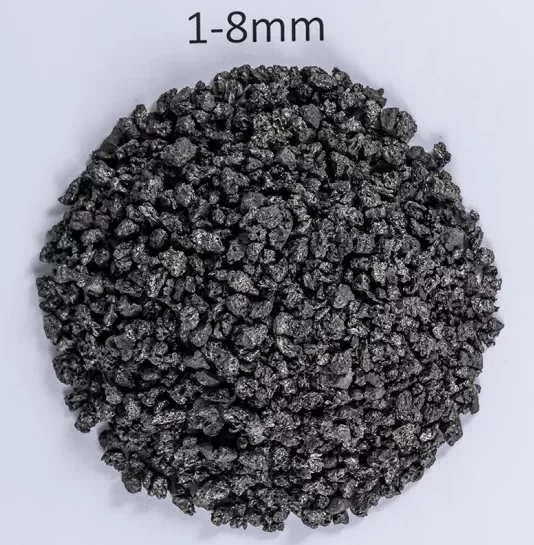
High-purity graphitized petroleum coke utilized for precise carbon adjustment in metallurgical processes.
◆ ◆ ◆
In This Article
◆ ◆ ◆
Structural Transformation via High-Temperature Graphitization

Visualization of the crystalline structure transition in graphitized carbon.
The transition from standard petroleum coke to a graphitized state is not a simple heating process but a fundamental crystalline reconfiguration. When subjected to temperatures of at least 2,600°C, the disordered, amorphous carbon structure is forced into a stable, hexagonal, lamellar graphite arrangement.
This structural shift is what defines the material's performance. By reducing porosity and increasing the regularity of the carbon lattice, the resulting material exhibits far superior dissolution rates in molten metal compared to non-graphitized alternatives.
—
Technical Evaluation of Carbon Purity and Impurity Control
For engineers, the value of a carbon raiser is determined by the balance between fixed carbon content and the presence of detrimental impurities. Sulfur and ash are the primary concerns; high sulfur levels can lead to brittleness in steel and undesirable phases in cast iron, while excess ash introduces slag-forming oxides that contaminate the melt.
The graphitization process inherently assists in the removal of volatile matter, but the quality of the initial petroleum coke feedstock remains paramount. A rigorous control system ensures that the final product maintains stringent sulfur limits, which is particularly critical for the production of ductile and grey iron where precise chemical boundaries are mandatory.
Beyond chemistry, the physical classification—ranging from 0-50mm—allows for the optimization of the charging process. Matching the particle size to the furnace's operational dynamics prevents material loss through "floating" or excessive oxidation, ensuring that the carbon is absorbed efficiently into the liquid phase.
—
The Dual Role: Recarburizer and Inoculant
In most metallurgical contexts, a recarburizer is viewed simply as a tool to increase the carbon percentage of a melt. However, specialized graphitized carbon serves a dual purpose by acting as both a carbon source and an inoculant, which is essential for controlling the graphite morphology in cast irons.
The ability of graphitized petroleum coke to promote graphite nucleation reduces the reliance on expensive separate nucleating agents, directly improving the ferrite content in ductile iron and optimizing the distribution of V-shaped and VI-shaped graphite.
This dual functionality is especially evident in precision casting and special steel smelting. By providing a stable nucleus for graphite growth, the material helps in achieving a more uniform microstructural organization, which translates to improved mechanical properties and reduced casting defects in the final component.
—
Performance Metrics for Metallurgical Integration
Selecting the appropriate carbon additive requires an analysis of multiple performance indices rather than focusing on fixed carbon alone. The efficiency of carbon absorption is a product of the material's crystallinity, surface area (determined by particle size), and the impurity profile.
When evaluating different grades of carbon materials, industrial buyers typically use a relative index to weigh the importance of purity against the cost of processing. The following model illustrates the relative importance of key parameters in high-precision foundry applications.
Figure 2. Relative Importance of Selection Parameters in Precision Casting
—
Operational Integration in Electric Furnaces and Foundries
In electric furnace steelmaking, the addition of graphitized petroleum coke occurs during the melting phase to supplement carbon and refine the chemical composition. The timing and quantity of the addition are dependent on the specific steel grade and the target carbon level, requiring a material that dissolves rapidly without introducing slag-forming impurities.
For foundries producing ductile or grey iron, the focus shifts to sulfur management. In these environments, low-sulfur GPC is utilized to ensure that the resulting cast products, such as auto parts or boiler components, meet strict mechanical specifications. The matching of particle size to the charging method is crucial here to prevent the material from being blown out of the furnace by the gas flow.
—
Strategic Sourcing and Manufacturer Assessment
Procuring carbon materials on a global scale requires more than a comparison of price per ton. The total cost of ownership is influenced by the consistency of the batches; a single shipment with fluctuating sulfur levels can lead to an entire batch of rejected castings.
Professional suppliers, such as those with decades of experience in the graphite and carbon sector, provide comprehensive Certificates of Analysis (COA) that define fixed carbon, sulfur, ash, and volatile matter. Sourcing directly from a factory allows for the customization of particle size distribution, which is often a requirement for specialized furnace configurations.
Ding An Heng New Material Technology Co., Ltd leverages over 20 years of production experience to supply these critical materials, ensuring that the graphitization process meets the rigorous thermal requirements (above 2,600°C) needed for industrial-grade recarburizers.
—
Comparative Analysis: GPC vs. CPC for Industrial Use
A common point of confusion in procurement is the interchangeability of Graphitized Petroleum Coke (GPC) and Calcined Petroleum Coke (CPC). While both are carbon-rich materials, the high-temperature graphitization step gives GPC a crystalline structure that CPC lacks.
CPC is an effective and cost-efficient solution for applications where extreme purity and specific nucleation properties are not required. However, for precision casting and special steel, the structural stability and lower porosity of GPC make it the technically superior choice despite the higher energy cost of its production.
The following table provides a decision framework for selecting between these two carbon raisers based on the production environment and required metallurgical outcome.
| Evaluation Factor | Graphitized (GPC) | Calcined (CPC) | Recommended Application |
|---|---|---|---|
| Carbon Structure | Crystalline/Lamellar | Amorphous/Disordered | High-precision alloys |
| Dissolution Rate | High/Rapid | Moderate | Electric Arc Furnaces |
| Impurity Level | Very Low (S, Ash) | Low to Moderate | Special Steel Smelting |
| Nucleation Effect | Strong Inoculant | Minimal | Ductile Iron Casting |
| Production Cost | Higher (Energy Intensive) | Lower | General Carbon Raising |
| Porosity | Low | Moderate | Precision Foundry Work |
◆ ◆ ◆
Questions & Answers
What is the fundamental difference between graphitized and calcined petroleum coke?
The primary difference lies in the crystal structure. Calcined Petroleum Coke (CPC) is treated at lower temperatures to remove volatiles. In contrast, Graphitized Petroleum Coke (GPC) undergoes a high-temperature process (usually above 2,600°C) that transforms the carbon from a disordered state into a crystalline, hexagonal graphite structure. This transformation significantly improves the material's purity, dissolution rate in molten metal, and its ability to act as an inoculant in cast iron production.
How does GPC contribute to the quality of ductile iron?
GPC acts as both a recarburizer and an inoculant. In ductile iron production, it promotes the nucleation of graphite, which increases the amount of nodular graphite and improves the overall microstructural grade. This often leads to increased ferrite content and a higher proportion of desired graphite shapes (such as V-shaped or VI-shaped), which enhances the mechanical properties of the casting and can reduce the need for additional, expensive nucleating agents.
Which parameters are most critical when specifying GPC for a foundry?
While fixed carbon is the primary goal, sulfur and ash content are the most critical purity parameters. High sulfur can lead to casting defects and brittleness. Additionally, the particle-size distribution (typically ranging from 0-50mm) must be matched to the furnace charging system to ensure the material doesn't oxidize or blow out. For high-precision work, moisture and nitrogen levels should also be evaluated to prevent gas porosity in the final cast product.
Can GPC be used in non-metallurgical applications?
Yes. Beyond steel and iron production, graphitized petroleum coke is utilized as an additive in the plastics and rubber industries to improve conductivity or mechanical properties. It also serves as a reducing agent in various chemical processes, a heavy metal absorbent for industrial wastewater treatment, and as a key raw material in the production of graphite cathodes for aluminum electrolysis cells.
What factors drive the pricing of graphitized petroleum coke?
Pricing is primarily driven by the quality of the raw petroleum coke feedstock and the energy costs associated with the graphitization process, which requires extreme temperatures. Specific chemical requirements (e.g., ultra-low sulfur) and tight particle-size distributions also increase production costs. Commercial factors such as order volume, packaging, and international freight (Incoterms) further influence the final landed price per ton.
How should a buyer evaluate a Chinese GPC manufacturer?
Buyers should evaluate the manufacturer's ability to provide consistent batch-to-batch specifications through a robust laboratory and inspection system. It is important to verify their production capacity, the specifics of their graphitization process (temperature and continuity), and their experience with export logistics. A professional supplier will ask for the specific application and furnace details to ensure the product grade and particle size match the actual production requirements.
◆ ◆ ◆
Final Thoughts
The selection of a carbon raiser is a technical decision that directly impacts the metallurgical integrity of the final product. For industries where impurity control and microstructural precision are non-negotiable, the structural advantages of graphitized petroleum coke provide a critical edge over traditional carbon additives.
By integrating a high-purity, crystalline carbon source, manufacturers can optimize their melting cycles, reduce the need for secondary inoculants, and consistently produce high-grade alloys. Success in this process depends on a precise match between the material's chemical profile, its physical dimensions, and the specific operational requirements of the furnace.


Latest news
×